Here’s a number that might stop you. Businesses with visible security measures experience up to 50% fewer break-ins than those without. That’s not a small difference. That’s the kind of stat that makes you rethink how you protect your property.
But here’s the catch. Not all security works the same way and when you start looking into options, you’ll run into two main choices. Vehicle patrol services and static guards. One moves around, covering lots of ground, while the other stays put, watching one spot full time. Both work. But they work differently.
This blog breaks down both options so you can figure out which one fits your situation. Because the right choice between patrol vs guard isn’t about what’s better in general. It’s about what’s better for you.
Understanding Vehicle Patrol Services
Let’s start with the option that moves.
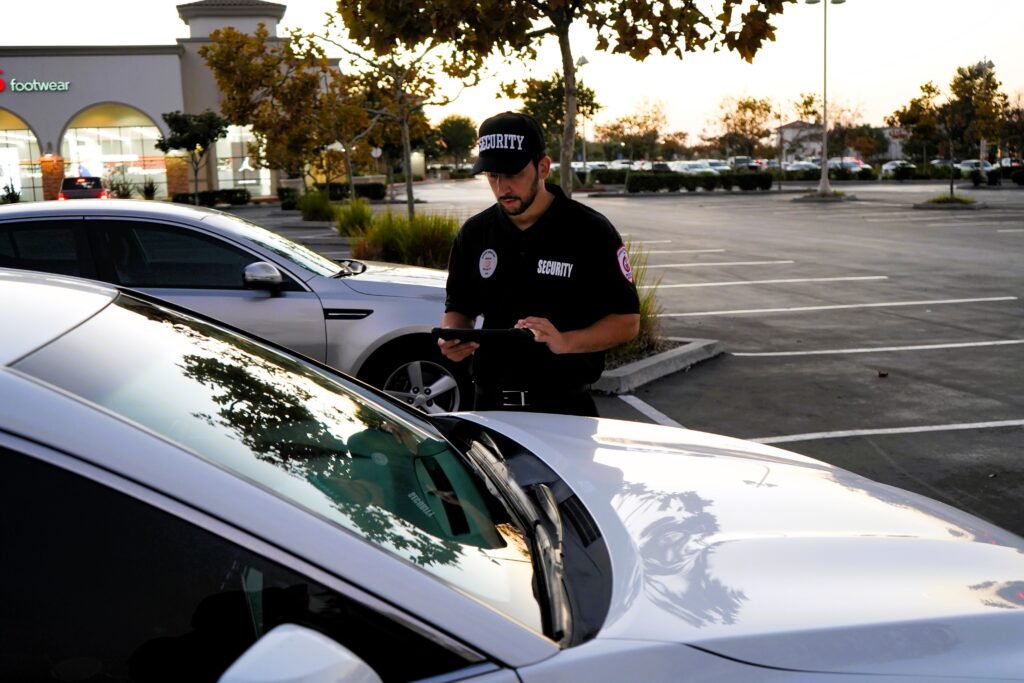
A vehicle patrol service involves security guards who travel through your property instead of staying in one place. They might drive marked vehicles along set routes, or they might show up at random times to keep people guessing. The goal is simple. Cover more ground with fewer people.
These security vehicle patrol teams handle a range of responsibilities:
- Checking perimeter fences and gates for breaches
- Responding to alarms when they trigger
- Monitoring parking lots and exterior areas
- Looking for signs of vandalism or trespassing
- Conducting foot patrols at key spots during rounds
The unpredictability is part of what makes them effective. Criminals can’t chase your property and learn when the guard shows up because there’s no set schedule. Sometimes it’s every hour. Sometimes it’s random. That uncertainty alone stops a lot of bad decisions.
How do vehicle patrols improve security coverage? By stretching your security budget across larger areas. A single patrol vehicle can monitor a warehouse complex, an office campus, or multiple retail locations in one shift. You’re not paying someone to watch one door all night. You’re paying for eyes on the whole property.
For businesses with spread-out layouts or multiple buildings, mobile security patrol makes financial sense. You get professional presence without the cost of stationing guards at every corner.
Understanding Static Guards
Now let’s look at the other side. The one that stays in place.
Static patrolling means exactly what it sounds like. Guards assigned to a fixed location where they remain throughout their shift. You’ll find them at building entrances, security desks, loading docks, or any spot that needs constant watching.
Their responsibilities are different from patrol teams:
- Checking IDs and managing visitor access
- Monitoring CCTV feeds in real time
- Logging entries and exits throughout the day
- Responding immediately to incidents on site
- Providing a visible presence that deters trouble
Security patrolling and static security posts serve different purposes. While patrols cover ground, static guards build familiarity. They get to know the regular faces, the normal routines, and the small details that tell them when something’s off. A guard who’s been at your front desk for months knows which delivery drivers belong there and which ones don’t.
Armed and unarmed guards both fall under this category depending on your risk level. A retail store might only need unarmed presence for theft prevention, while a bank or jewelry store probably wants armed protection. Either way, the key difference is their fixed position.
What is the major difference between a static patrol and a mobile patrol? At its simplest, one stays and one moves. But the real difference is what they protect. Static guards protect specific points. Mobile patrols protect entire zones. Neither is better. They just do different jobs.
Comparing Vehicle Patrols vs Static Guards
Now that you understand both options, let’s put them side by side. Because the difference between patrol and static security duty isn’t just about moving versus standing still. It’s about what each approach actually delivers.
Here’s how they stack up:
| Feature | Vehicle Patrol | Static Guards |
| Coverage | Wide area, multiple locations | Focused on one specific site |
| Presence | Intermittent but unpredictable | Continuous and visible |
| Response Time | Fast, depends on location | Immediate, already on site |
| Cost | More cost-effective for large properties | Higher for 24/7 coverage |
| Flexibility | Randomized schedules, easily scaled | Fixed schedules, less adaptable |
| Best For | Warehouses, campuses, industrial sites | Retail, offices, sensitive zones |
Comparing patrol and static security really comes down to matching the approach to the property. A 24 hour gas station needs someone at the counter. A construction site spread across five acres needs someone circling the perimeter.
The vehicle security patrol approach comes in handy when you need eyes in multiple places without breaking the bank. One patrol vehicle can check every door, every fence line, and every dark corner of a large property in a single shift. Try doing that with static guards and you’d need a dozen people.
But here’s the tradeoff. Static guards offer something patrols can’t. Immediate presence. When something happens at the front door, your static guard is already there. No driving time. No checking in from another location. Just an instant response.
That’s the core of static and patrol vehicle comparison. One trades instant response for wide coverage. The other trades wide coverage for constant presence. Neither is wrong. They’re just tools for different jobs.
When Vehicle Patrol Services Are More Effective
Some properties just make more sense for patrols.
If you’re managing a warehouse district, a business campus, or any site with multiple buildings spread out over acres, vehicle patrol security services give you coverage you couldn’t afford any other way. One patrol vehicle can check every door, every fence, and every dark corner in a fraction of the time it would take a dozen static guards.
The advantages of vehicle patrols for large properties come down to simple math. You pay for one team instead of ten. That team covers ground efficiently. And because their schedule is unpredictable, criminals can’t plan around them.
These services also shine for after-hours protection. When your business closes and the employees go home, a patrol vehicle circling the property tells anyone watching that someone is still paying attention. That alone stops a lot of break-ins.
So which is more effective, vehicle patrol or static guards for your situation? If your property is large, spread out, or only needs protection during off hours, patrols usually win.
When Static Guards Are More Effective
Now let’s talk about the situations where you want someone standing right there.
Retail stores need static guards at the entrance during business hours. Not just for theft prevention, but for customer service too. A guard who greets people and keeps an eye on things does double duty. They protect your inventory while making shoppers feel safe.
Corporate offices rely on static guards for access control. Someone needs to check IDs, manage visitor logs, and make sure only authorized people get past the lobby. A patrol vehicle driving by every hour can’t do that.
What type of security service suits my business needs when you handle cash or high-value goods? You want someone posted at the door. Banks, jewelry stores, and pharmacies all fall into this category. The risk is too high to leave entry points unwatched even for minutes.
Static guards also make sense for smaller properties where one person can see everything from a single spot. If your whole facility fits inside a guard’s sightline, why pay for patrol coverage you don’t need?
Factors to Consider When Choosing
You’ve seen both options. Now let’s talk about how to actually decide. Because how to choose between patrol services and static guards isn’t about picking a winner. It’s about matching the solution to your specific situation.
Here are the key factors to weigh:
Size and Layout of the Property
If your property covers a large area with multiple buildings or parking lots, vehicle patrols make more sense. One patrol vehicle can cover ground that would require a dozen static guards. If your property is compact and everything fits within a single sightline, static guards give you the same protection at lower cost.
Risk Exposure and Crime Rate
High crime areas need visible, constant presence. Static guards at entry points tell criminals your property isn’t an easy target. For lower risk areas where your main concern is after-hours vandalism, patrols provide enough deterrence without the expense of 24/7 staffing.
Budget and Operational Hours
Static guards cost more because you’re paying for someone to be there every minute. Vehicle patrols spread that cost across time and space. If you only need protection during off hours or can’t afford full-time coverage, patrols stretch your budget further.
Nature of Business and Security Needs
A bank needs different protection than a construction site. Retail stores need customer-facing guards. Warehouses need perimeter checks. Think about what you’re actually protecting and what threats you face. That usually points you toward the right answer.
Final Thoughts
Vehicle patrols and static guards both work. They just work differently. Patrols cover wide ground at lower cost, perfect for large properties and after-hours protection. While static guards provide constant presence and instant response where access control matters most. The right choice depends on your property size, your risk level, and what you’re actually trying to protect.
If you’re managing a warehouse district, a business campus, or any site with multiple buildings spread out over acres, Onpoint Patrol has you covered. Our vehicle patrol service gives you professional security coverage you couldn’t afford any other way. Call us at (888) 436 6986 or visit https://onpointpatrol.com/service/vehicle-patrol-service/ to learn more.
FAQs
1. What is the major difference between a static patrol and a mobile patrol?
Static guards stay in one location for constant monitoring, while mobile (vehicle) patrols move around to cover larger areas and respond to incidents across multiple sites.
2. Which is more effective, vehicle patrol or static guards?
Effectiveness depends on your property. Vehicle patrols excel for large, spread-out areas or after-hours coverage. Static guards are better for access control, high-value sites, or customer-facing security.
3. How do vehicle patrols improve security coverage?
Vehicle patrols extend coverage across multiple locations or large properties, provide unpredictable monitoring, and respond quickly to alarms, maximizing protection with fewer personnel.
4. How to choose between patrol services and static guards?
Consider property size, risk level, operational hours, and business type. Large or multiple sites benefit from patrols, while high-risk or customer-facing locations need static guards.
5. What type of security service suits my business needs?
Use patrols for expansive or after-hours coverage and static guards for fixed-entry points, access control, or areas with valuable assets. Many businesses combine both for layered security.